Discover the Beauty of Portuguese Tiles – The New Face of Portuguese with Carla

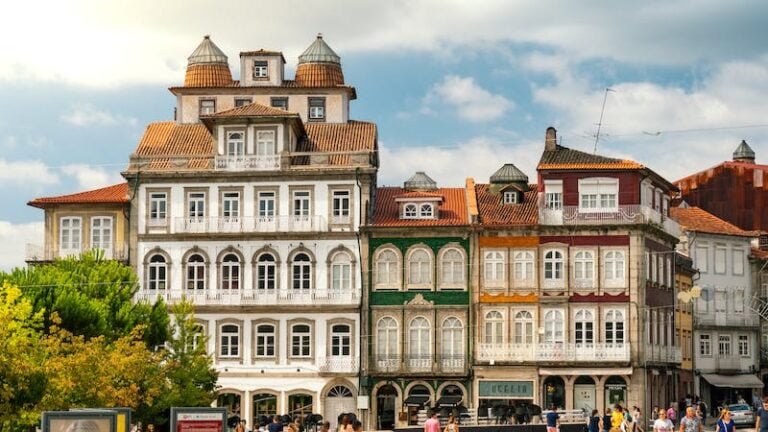
Tiles are among the most distinctive characteristics of Portuguese architecture. No matter where you go in the country, you will find houses lined with beautiful squares of bright ceramic. Some are blue and white with floral patterns, while others have geometric patterns. Regardless, there is no denying that they are one of the aspects that most captivate those who visit Portugal.
Where does this tradition come from? How did the tiles become one of the most iconic Portuguese symbols? And what do they have to do with Portuguese with Carla?
In this post, discover more about the beautiful Portuguese tiles. Explore their history, how they are made, and how to distinguish them.
Lastly, we have some exciting news! Our team has been working on a rebranding that will elevate your learning experience. Stay with us to learn all about it!
An Intro to Portuguese Azulejos
Tiles are a common decorative and functional item used in many other countries and cultures. You can find them all over Europe, South America, and the Middle East. In fact, the word azulejo means “polished stone” in Arabic.
They usually have a square form and are common in Portugal and Spain. Found in art, tradition, and architecture, azulejos serve both ornamental and functional roles. Did you know they serve as a temperature regulator in homes?

Below, discover more about the traditional methods used to create these original tiles. Then, travel back to the 15th century to explore their history. Finally, learn why azulejos are so important for the Portuguese with Carla team and uncover huge news from us!
Production of Portuguese Tiles
Producing Portuguese tiles is a complex and labor-intensive process. It starts with the creation of the design. Most companies now use specific software, but some still create designs by hand.
Then, it is time to mix and knead the clay, followed by molding and drying of the actual tiles. The first firing hardens them into biscuits. Next, a smooth, white glaze is applied. This is also the stage in which the designs are applied using metallic oxides. Then, there is one last fire in the kiln to fuse the glaze and color.
The last stage is assembling and installing the tiles. Once again, this phase can be done by hand or using specialized equipment.
Preservation for Future Generations
Besides tile making, many companies today focus on reconstruction. Although they last for a long time, some tile panels are ancient and require regular maintenance. Hence, it is common for specialized companies to take on upkeep projects.

Conservation ensures future generations can enjoy and understand the importance of tile making. Additionally, some of the Portuguese modern art has been inspired by ancient traditions like azulejo.
The History of Portuguese Tiles
The art of tile-making has been passed on for centuries up to the present. Ancient tiles were first produced in Egypt. Later, they were introduced by the Moors in the Iberian Peninsula, around the 13th century.
In Portugal, tile production dates back about 500 years. The largest and most ancient tile-making tradition is focused in the Central and Northern regions of the country. Regions like Lisbon, Aveiro, and Porto are still home to some of the most famous tile factories.
Throughout the centuries, the Portuguese have used tiles in palaces, churches, and other buildings. Azulejos became an integral part of Portuguese culture and identity. They were used to decorate the entrances and interiors of historic buildings. Often, artists were hired to create intricate patterns and paintings using polished stone. They were used to tell stories and convey messages.
One such example is The Mother Church of Válega (Church of Santa Maria de Válega) in Ovar. It is remarkable for its façade and interior lined in 20th-century polychrome tile panels depicting biblical scenes. The building’s construction lasted more than a century, from 1746 onward.
Today, the azulejo tradition has also been recognized and protected by UNESCO. As a result, azulejo art is being preserved and restored all around the world.

Different Types of Portuguese Tiles
There are many different types of Portuguese tiles. The most common and iconic ones are blue and white tiles, often used in façades and inside buildings. But there are other styles, each with its own unique characteristics. For example, polychrome tiles feature a range of colors and designs. Additionally, maiolica tiles are made using a specific type of glaze.
Besides the materials used, azulejos are also classified by production method. Some are made using the traditional techniques. Others are produced according to more modern and innovative methods. The type of tile applied in each case depends on the intended use and desired aesthetic.
Decorating with Portuguese Tiles
Once you start noticing tiles in Portugal, you will never stop. They appear not only in historic settings, but also in modern and contemporary designs. The next step is to use them as decoration. Although they seem simple, they bring a warm, distinctive, yet elegant touch to every room.
Besides, Portuguese tiles are extremely versatile. You can use them to decorate everything from walls to floors and ceilings, and combine them with other materials. They can even be incorporated into functional elements. For example, in homes and restaurants, you will see them in furniture items, like tables and chairs.

Buying Portuguese Tiles
When in Portugal, you can easily buy Portuguese tiles and tile-decorated items. You can find them at local souvenir shops and other businesses. However, the locals prefer to get them directly from factories, workshops, or specialty stores. This way, you ensure you are buying an authentic item that will last.
The amount and type of tile products you buy will always depend on your goal. Most shops have a wide range of designs and options. Thus, conducting some research beforehand can help you determine what you are looking for and select the best option for your budget. Either way, it is an incredible idea to take a piece of Portugal with you and share it with others who will also appreciate this Portuguese heritage.
Azulejos at Portuguese With Carla
At Portuguese with Carla, we have always strived to give you the full Portuguese experience. Our course, The Journey, does more than teach you a language. It is based on a feature film made by natives in Portugal and filled with cultural cues (and many tile-lined national landmarks).
This science-proven method transports you all the way to Portugal without leaving your own home. You hear native people with real accents, explore idioms, and local customs. Hundreds of you are already seeing the results of this approach in your own lives.
But Portuguese with Carla is changing, and we want to tell you all about it.
The Same Concept, a Brand New Image
Portuguese with Carla is turning into Portuguese with Carla and Friends – the same essence with a brand new image. Our team has expanded, and our community is growing every day. Thus, for the past year, we have been listening attentively to our members.
We have done our best to deeply understand your thoughts and concerns regarding learning Portuguese. After all, you are part of Portuguese with Carla, and it is because of you that we want to keep improving.

As you have probably noticed, we are changing much of our visual image. We have a new logo, colors, and fonts to reflect a new vision under the same essence and mission. We chose a take on a traditional Portuguese tile to represent our new brand image.
This rebranding highlights the beauty, tradition, and continual evolution of azulejos, mirroring the way we aim to grow and adapt our language teaching to and for you. That is why this is not just another redesign. Instead, it is a reflection of your voice, your needs, and your growth.
If you are a member of The Journey, you already have access to its brand new version. There are a lot of exciting new things to explore and discover. But whether or not you have an active subscription, we want to let you in on what is new.
What You Can Expect From The Journey 2.0
The new version of The Journey is more intuitive, more empowering, and more aligned with the way you learn best. Some of your biggest concerns were related to guidance, navigation, and growth. For example, some of you expressed feeling lost or simply not being able to follow your personal growth.
Hearing your doubts and digging into them in detail was the inspiration behind The Journey 2.0. This new version of The Journey is all about clarity, confidence, and motivation.

Here is what you can expect:
- A more intuitive, streamlined homepage that helps you find your way with ease
- A new way to visualise your progress across different areas of the language
- A clearer sense of where you are, where you are going, and how far you have come
Are You Ready to Meet Us?
Much like azulejo is an integral part of Portuguese tradition, our values are part of what defines us. But one of the most beautiful things about traditions is how much space they allow for growth and reinvention. As you know, we are always looking to improve, and you are the driving force behind everything we do.
That is why we are proud to introduce Portuguese with Carla and Friends and The Journey 2.0. More than a change of visual, we have set out to deliver a massive improvement while preserving our pillars, values, and essence. The result is the best possible Portuguese learning adventure. At Portuguese with Carla and Friends, we can not wait to meet you! Ready to transform your Portuguese journey? Click HERE now and start learning with us today!